
The Bertrand family
Biodynamic red wines

At Gérard Bertrand, biodynamics is a virtuous circle. It takes into consideration a holistic vision of living things. Since agroforestry and cover crops energise the land by proliferating micro-organisms. It was in 2002 at Domaine de Cigalus that the adventure of biodynamics according to Gérard Bertrand began.
Many observations and tastings motivated him to integrate this philosophy into the field with his teams. Today, the soils are full of life and biodynamic red wines are crafted from ripe grape berries with far better acidity than in the past. Moreover, biodynamics also involves a diffusion at a homeopathic dose of medicinal plants, sprayed according to the lunar cycle to strengthen the immune system of the vine. Thus, in good health, the vine yields deeper biodynamic wines filled with emotion.
A vitality energised by the infinitely small

Biodynamic viticulture is an art of precision that requires being a keen observer in order to make decisions at the right moment. All while performing gestures that carry their full importance, applying the infinitely small and sometimes invisible to the naked eye.
Micro-organisms: one of the secrets of Great Red Wines
Biodynamics goes beyond organic farming. The aim in biodynamics is to strengthen the immune system of the vine plant. It is a symbiosis often described as mystical. Yet, it is between the earth, the vine, the animals and humans that this synergy operates using purely natural methods. Biodynamic work is carried out with the greatest care for the soil to encourage the presence of mineral and organic compounds that can be assimilated by the vine. This clay-humus complex with its rich micro-organism activity is one of the secrets of Great Red Wines.
Dynamisation: a vortex of information from the infinitely small
Dynamisation consists of dissolving medicinal plants in a vessel and setting them in motion so as to form a vortex. Thus, just like the principle of homeopathy, the plants transfer to the water the information they contain. Then, abruptly, the vortex formed must be broken by making it spin in the opposite direction. Also, water in motion encourages significant oxygenation, activating the release of the active compounds contained in the medicinal plants. Subsequently, these preparations are administered at a homeopathic dose to the vine or to the soil in order to strengthen the vine plant.
Discover the collection of Demeter biodynamic wines by Gérard Bertrand.
Biodynamics influences the singularity of red wines
In biodynamics, the living soil reveals its typicity even more through the taste of the wine.
The grape varieties of biodynamic red wines: the expression of terroirs
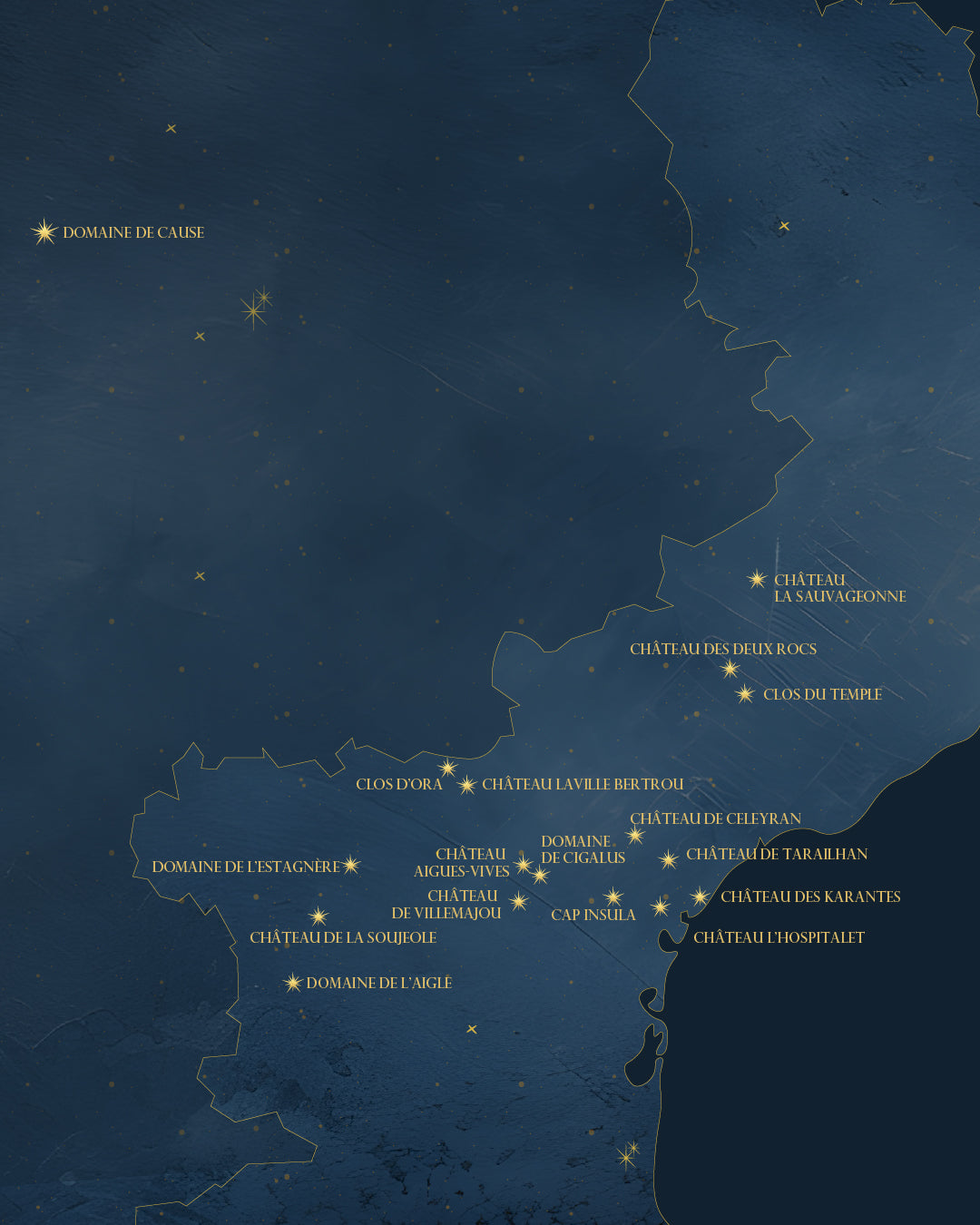
The biodynamic red wines of Gérard Bertrand are born from the communion between red grape varieties and the soils on which they flourish. Thus, in the blends of his biodynamic wines from the Languedoc, Syrah stands up against the seductive power of Grenache, in contact with the velvety touch of Mourvèdre and the freshness of Carignan. As at Clos d'Ora, biodynamics stimulates the dissolution of soil minerals, magnifying the aromatic expression of the terroirs. And also, Merlot becomes sharper, Cabernet-Franc unfolds its elegance, whilst Cabernet-Sauvignon reveals its linear character and Mourvèdre exhales its potential. Thus, each clay, schist, limestone and granite soil infuses a specific intensity into the red wine.
Deep biodynamic red wines of great finesse
Assuredly, the gustatory superiority of organic wines over traditional wines is unanimously recognised. However, the aromas of biodynamic red wines come from combinations of molecules and not from a single molecule. This identification is moreover observed in synthetic aromas, which have no finesse compared to natural extracts, which have a far more interesting aromatic complexity.
Furthermore, red wines produced using biodynamics show greater acidity and depth. The minerality is more pronounced, offering a better gustatory balance in the wine. Also, the salinity — which is moreover a characteristic of the wines of La Clape at Château des Karantes, derived from mineral salts — is more present, allowing greater longevity over time. Thus, the evolution of the wine is stable. This is why biodynamic red wines express themselves in such a singular way.
Biodynamic red wines — emotion in a bottle
To experience an emotion when tasting a wine, the richness and concentration of a wine alone are not enough. Biodynamic winegrowing practices and monitoring throughout the ageing process will determine the character and elegance of the final red wine.
Biodynamic red wines: a moment of fulfilment and voluptuousness
Wine carries the memory of its terroir, its grape varieties and the conditions of the vintage. Its colour, its aromas, its flavours and its sapid character are vectors of emotion. Indeed, even if a wine is tasted after one year or ten years, it remains the messenger of its vintage, traversed by memories.
Biodynamic red wines are imbued with an energy inviting one to fully enjoy their tasting and to savour the moment. The robe of a red wine draws the eye. Its colour, its hue, its intensity and its luminance are the beginning of a sensory journey that leaves no one indifferent, plunging into a moment of fulfilment and voluptuousness.
The most delicious and emotional food and wine pairings
However, sharing them in convivial moments, around a meal with local cuisine, is an opportunity to create the most delicious food and wine pairings. Take the case of a pure-bred Aubrac rib of beef accompanied by grilled garlic with olive oil, with the Château La Sauvageonne Grand Vin Red with its bouquet of garrigue fragrances and spiced jammy nuances. This intense wine takes you on a journey to the land of its volcanic terroir. Its freshness and beautiful acidity on the palate, with fine and elegant tannins, retranscribe this wild place where it evolves. And also, for indulgent food and wine pairings, a Grand Cru Manjari chocolate mousse savoured with a thyme ice cream and a blackcurrant reduction alongside the Domaine de Cigalus. Born of its Mediterranean climate, its concentration of ripe, spiced and toasted dark fruits reveals itself in a luscious palate with velvety tannins and a long, perfectly balanced finish.
The quiz to help you choose which biodynamic wine suits you best.
The whole collection of our organic and biodynamic wines
List of biodynamic red wines :
- Château L'Hospitalet : this Grand Vin Red certified DEMETER can be enjoyed right now whilst also having a very promising future.
- Château des Karantes : this Grand Vin Red is cultivated organically and biodynamically.
- Château La Sauvageonne : certified organic and DEMETER wine to enjoy now or to keep for a few years.
And also,
- La Forge : from 100-year-old vine stocks cultivated and vinified with the greatest care.
- Or also, discover the collection of our white wines.
- And also, the haute collection of red wines by Gérard Bertrand.
Learn more about orange wine, the white wine and find out everything about organic rosé wine.
Discover the best Gérard Bertrand wines :
Our latest news
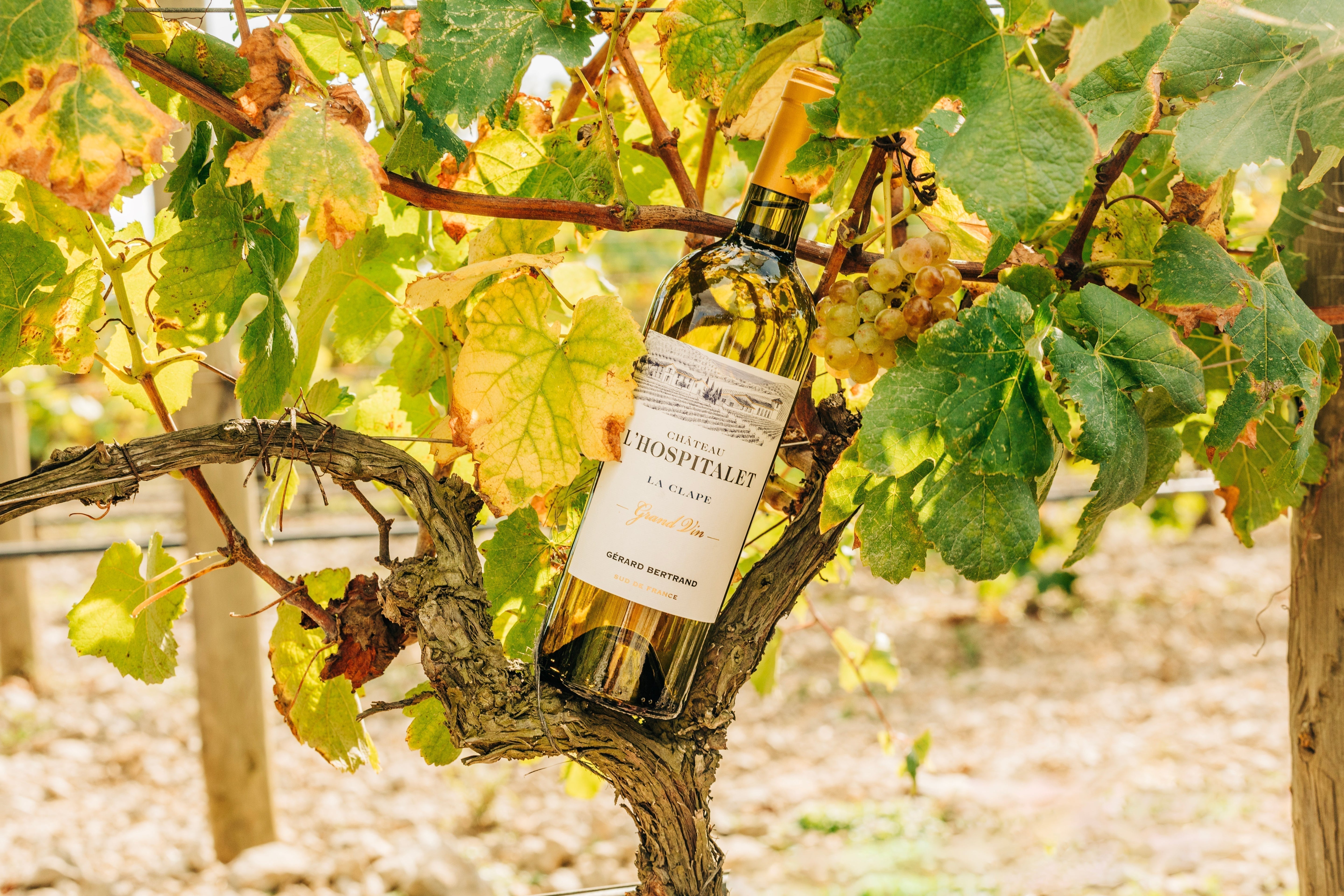
Château l'Hospitalet Grand Vin
Discover a Grand Vin White shaped by the sea, altitude and the minerality of La Clape.
Read the article
Win 2 VIP Tickets for Jon Bon Jovi — Hampton Water Competition
From 30 June to 15 August 2026, try to win 2 VIP tickets to the Jon Bon Jovi concert on 28 August in Edinburgh.
Read the article
A Second Life for Our Wooden Crates
A fine example of reuse: in Germany, our wooden crates are finding a second life with an association committed to protecting bats.
Read the article